How it works

The Workspace

Open source

FAQ

One investigation thread for every bug ticket.

OpenBug runs your services, captures runtime evidence, and correlates what happened across them, so each ticket becomes one clear investigation, not five terminal tabs.

Install OpenBug

D

View on GitHub

Local-first // Open-source // Multi-service

Report

Export a root-cause report with evidence and a patch.

Correlation

Pins across services keep the ticket thread coherent.

Workspace

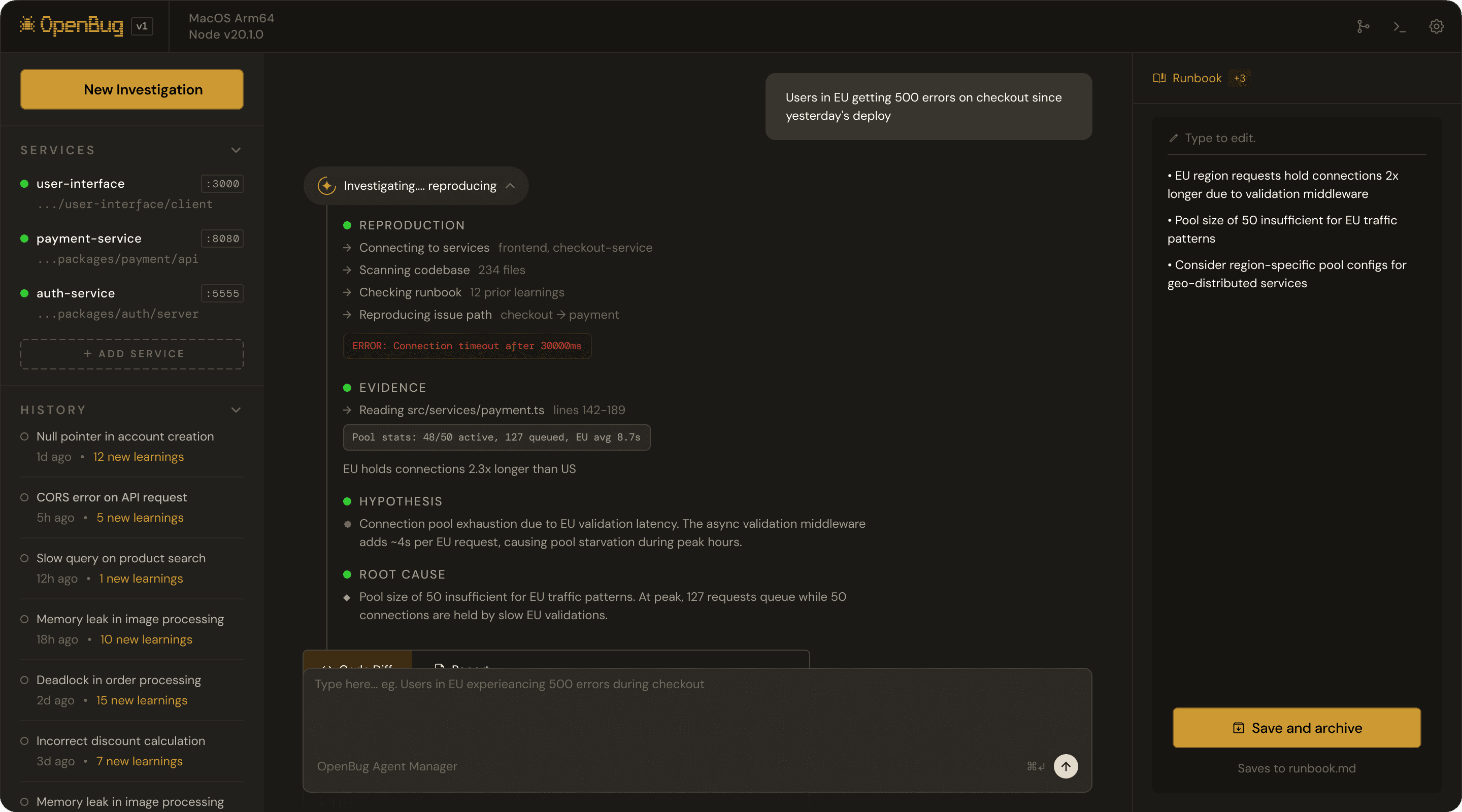
One place for services, evidence, and the investigation.

Why it feels different

Not another code chat tool

Code tools help you write and edit. OpenBug helps you investigate tickets across services—by keeping one coherent thread of evidence.

Typical workflow

Open 5–10 terminals

Grep logs per service

Ask AI in one context

Lose the thread across services

OpenBug workflow

Services visible and monitored at once

Investigation thread cites evidence pins

One place to jump logs → code → diff

Export a root-cause report for review

How it works

Turn tickets into a single investigation

Connect services once. Reproduce the issue. Follow one thread to root cause and the next change.

STEP 1

Connect services

Connect services

Start your services through OpenBug so each one is monitored in isolation.

STEP 2

Reproduce the ticket

Reproduce the ticket

As you test, OpenBug captures runtime signals and pins relevant evidence.

checkout OK

orders warning

payment timeout

STEP 3

Get the diagnosis

Get the diagnosis

OpenBug correlates evidence across services into one investigation thread, then proposes a patch you can review.

Root cause: orders/queue.js:47 Fix: await payment confirmation Export: root-cause report

WHAT YOU GET

A ticket debugging workspace

Built for multi-service reality, without squeezing logs into a tiny pane.

Services at a glance

Health, last error, and evidence pins per service—so you instantly know where to look.

Investigation thread (the core artifact)

Investigation thread (the core artifact)

Investigation thread (the core artifact)

A structured thread that names the service it checked, cites evidence, links to code, and ends in a sharable root-cause report.

Evidence pins

Jump from "this log line" → "this file" → "this diff" without losing the ticket narrative.

Report export

Turn junior investigations into senior-reviewable reports: summary + evidence + patch.

Open-source

Local-first. Transparent. Hackable.

Own your workflow. No lock-in. Keep your code and logs on your machine by default.

Local by default

Run where you debug: on your laptop. Keep data control simple.

Bring your model

Plug in your preferred LLM provider or local models (as supported)

Community-driven

Contribute features, share workflows, and help shape the debugging stack.

Get started

Install and open the workspace

Replace these commands with your real install + quickstart.

Star on GitHub

Read the docs

NPM

npm install -g oncall-cli

NPM

npm install -g oncall-cli

WHAT OPENBUG IS, AND ISN't

Frequently asked questions

Quick answers on when OpenBug helps, how it fits your workflow, and what it’s not built for.

Why not just use Claude/Cursor with logs?

Why not just use Claude/Cursor with logs?

Why not just use Claude/Cursor with logs?

Is this only for microservices?

Is this only for microservices?

Is this only for microservices?

Does data leave my machine?

Does data leave my machine?

Does data leave my machine?

What's the core output?

What's the core output?

What's the core output?

How much does OpenBug cost?

How much does OpenBug cost?

How much does OpenBug cost?

Open-source ticket debugging workspace

© 2026 OpenBug. All rights reserved.